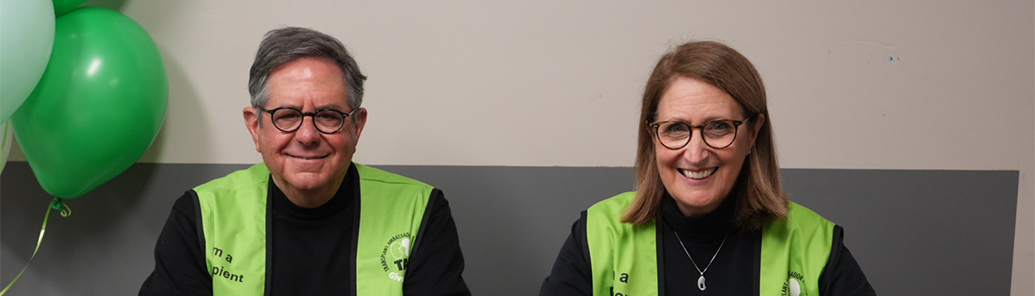
Two kidney donor ambassadors at the Montreal General Hospital
March 17th, 2026
News
March 12 marked World Kidney Day, as well as the launch of a peer support program at the MUHC for patients with chronic kidney disease who are undergoing kidney transplants.
“I had already agreed,” says Christine Pisapia. “No hesitation. It was planned - I was ready.”
But her brother Serge was still hesitant. He preferred to receive a kidney from a deceased donor. “Why put a loved one at risk when you can receive an organ from someone who has passed away?”
Christine, however, had no doubts. “When you commit, it means you’ve really thought through your decision.”
At the last minute, Serge was offered a kidney from a deceased donor and told his sister. “Being told you can’t donate a kidney less than a month before the planned date is really hard. It’s like telling a runner, the day before a race, that they can’t participate after all,” admits Christine.
But things became complicated, and that option became impossible. Meanwhile, Serge’s health was deteriorating, and the need for a transplant became increasingly urgent.
Finally, the stars aligned in 2014, just a few months before the Royal Victoria Hospital moved to the Glen site. Christine underwent a nephrectomy to donate a kidney to her brother, while Serge waited for the organ in an adjacent operating room.
Twelve years later, the brother and sister returned as volunteers at the MUHC, including with the Transplant Ambassadors Program (TAP), a nonprofit organization, at the Montreal General Hospital.
Sharing a personal experience
Deciding to donate a kidney is never easy. That’s why Serge and Christine want to share their experience with others.
“Whether it’s talking about family experiences, the challenges of dialysis, the effects of anti-rejection medications… basically, any questions someone considering a transplant or kidney donation might have, we’re here,” explains Christine.
Already well established in Ontario’s healthcare system, the program is being launched for the first time in Quebec, starting at the Montreal General Hospital. TAP connects patients with chronic kidney disease and their families to mentors (ambassadors) who have personally experienced a kidney donation or transplant.
“Doctors and clinical teams can explain the medical aspects of transplantation, but hearing from someone who has lived it adds a whole different dimension,” explains Vicki Tan. “It helps patients imagine the process and better understand what it involves.”
Every member of the ambassador team has personal experience with organ donation or transplantation. Many speak multiple languages and make themselves available to speak with patients who want to learn more.
A concrete option for patients
For Serge and Christine, a peer support program like this would have been invaluable when they went through the process.
“We would have really loved to have a service like this to rely on,” says Christine. “So today, we’re even happier to be able to offer it to others.”
The Transplant Ambassadors Program is currently in the midst of a recruitment campaign at the MUHC. The goal is to train new ambassadors who can share their experiences with patients who have questions about transplantation or living donation.
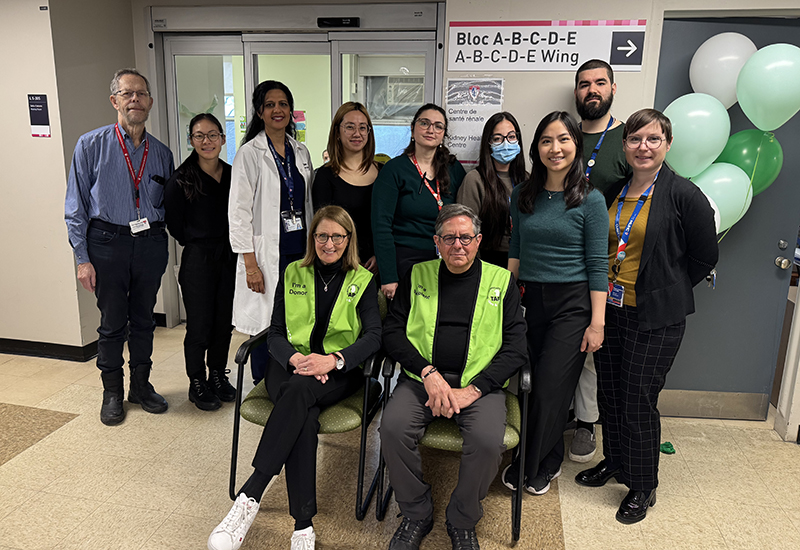
This was also one of the reasons the siblings recently visited the Kidney Protection Clinic at the Montreal General Hospital, meeting with patients and families eager to learn more.
For Myriam Ménard, a program like this can play a crucial role:
“For many patients and their families, living donation can seem abstract or intimidating. A program like this lets them see what it really means, through the experiences of people who have gone through it.”
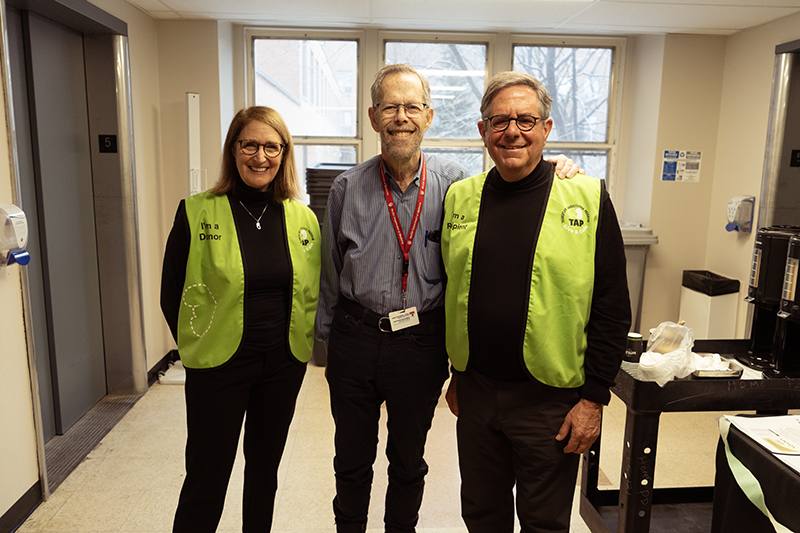
Located near the Kidney Protection Clinic, Serge and Christine’s information booth also drew a visit from Serge’s former nephrologist, Dr. Murray Vasilevsky, who had cared for him for over 20 years at the MUHC — a meeting filled with emotion.
Putting a face to transplantation
For Jerrica McKinnon, the strength of the program lies in the ambassadors’ own voices.
“The program creates a space where patients and their families can ask any questions, without pressure,” she explains. “The ambassadors speak authentically about their experiences, and that can really help someone who is hesitant or trying to understand what lies ahead.”
By sharing their story, Serge and Christine hope above all to demystify living donation and encourage conversations about transplantation.
Because behind every successful transplant, there is first and foremost a human story — one of a thoughtful decision, an act of generosity, and, sometimes, a second chance.
Listen to Christine, Serge, and their brother Jean-Marc tell their story. (in French only)
WEB.jpg)