Seeing access through a new lens
To mark the International Day of Persons with Disabilities on December 3rd, five volunteers with the MUHC Accessibility Committee spent part of their workday in a wheelchair. The purpose was simple: step into the experience of people who live with mobility challenges every day, learn from it, and bring these insights back to the MUHC community.
The idea came from patient-partner Diane States, who uses a wheelchair and has long championed accessibility improvements. “My main priority was to get the committee to see the issues,” says Diane. “I think I accomplished that.”
Rolling through the Glen, The Institute and The Neuro
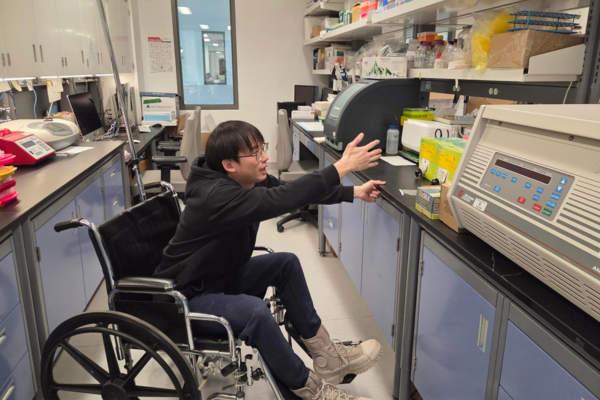
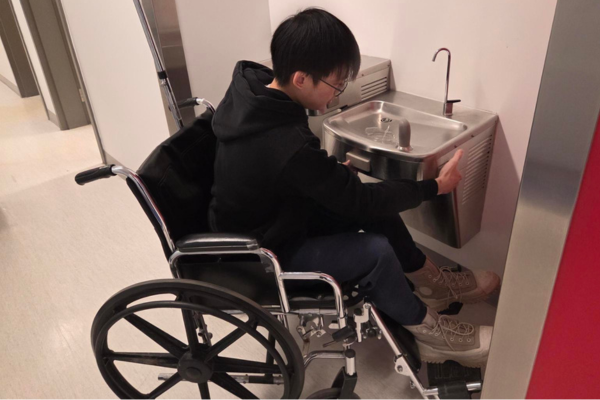
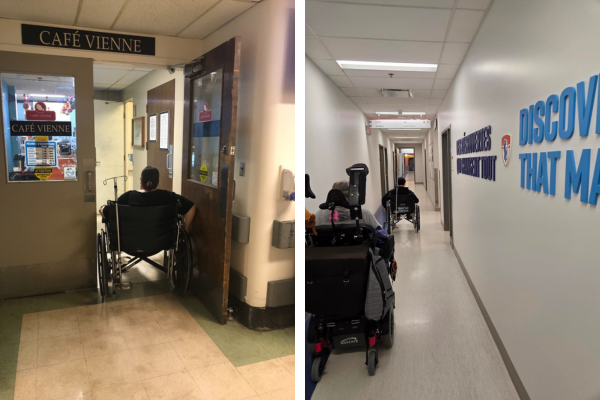
The activity took place at three locations: the Glen site, The Institute and The Neuro. Each volunteer explored real-life situations—going to the cafeteria, shops, washrooms, The Institute atrium, labs and administrative areas to see what works well, what doesn’t, and how accessibility could be enhanced.
What our volunteers experienced
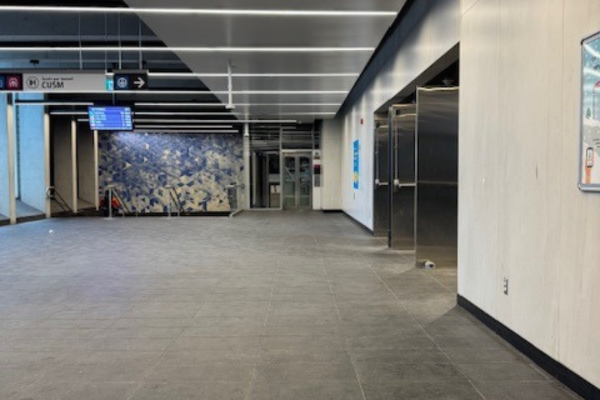
Communications Manager Rachel Hawes kicked things off from her office at 5100 de Maisonneuve. She quickly realized how much effort it takes to push a wheelchair. “Diane offered to tow me through the tunnel to the Glen site,” admits Rachel a bit sheepishly. “Obstacles like getting to the washroom, buying a muffin, and navigating cramped spaces were my general observations.”
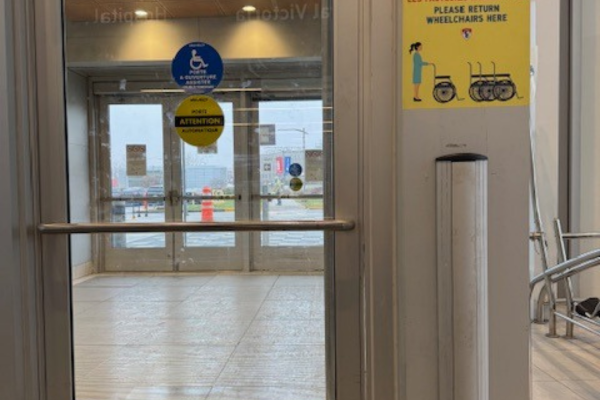
Heavy doors and poorly timed automatic doors proved challenging for volunteer Jiahao Deng, from The Institute. “Every time I tried to open the doors, it was really difficult,” he says. It took three attempts to get through the main entrance, but the biggest challenge came from doors without automatic entry. “Because of my inexperience, I had to use the doorframe to pull myself through, and when I tried to push the doors open, the wheelchair would roll backward.”
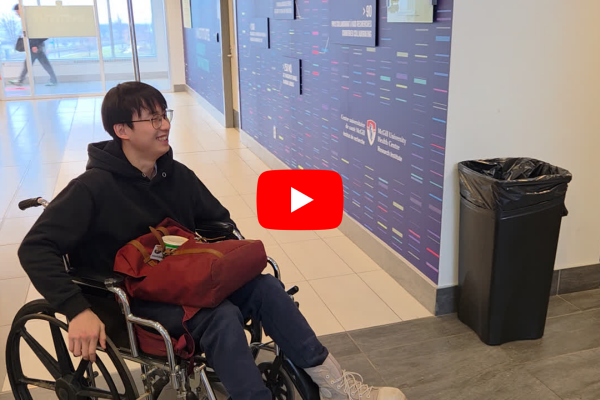
Diego Herrera, Equity, Diversity and Inclusion Specialist at The Institute adds, “I think this experience helped identify some issues and highlighted areas where we are doing well, such as administrative areas with cubicles adapted for people with mobility difficulties.”
Some small improvements have already been made based on the volunteers’ experience. “We extended the time for the main elevator doors at The Institute to remain open to allow people in wheelchairs to enter,” says Fadi Aoun, Manager of Building Operations and Maintenance. Technical Services is also coordinating with the private partner, Groupe immobilier santé McGill (GISM), on other accessibility initiatives, such as motorizing some doors to improve wheelchair accessibility
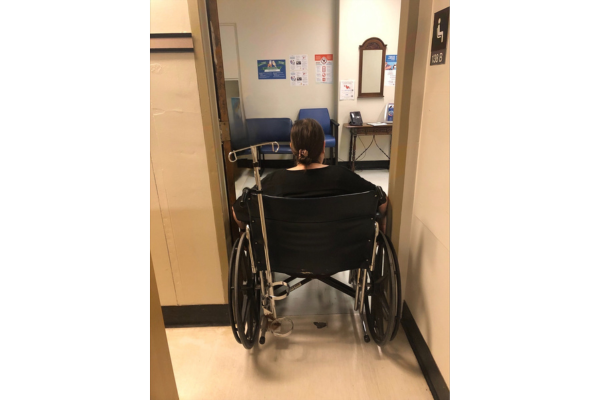
At The Neuro, Librarian Sabrina Burr faced different challenges in the older building. Tight door frames, difficult floor transitions, a steep ramp and narrow turning spaces made simple movements hard. Sabrina and Viola Grasso, Coordinator of Administrative Services, who also participated in the activity, are reflecting on their experiences to help improve wheelchair accessibility at The Neuro.
Looking ahead
All findings from this activity will be compiled and shared with senior management, along with some recommendations for next year that focus on simple, low-cost improvements with immediate impact. Reflecting on the experience, Accessibility Committee Co-chair Deborah Fleming says, “This activity highlighted the physical demands of using a wheelchair. By the end, I was not only physically drained but emotionally exhausted as well.”
This important activity highlighted not only the obstacles, but also the resilience and determination of wheelchair users.

For more information on Accessibility at the MUHC, visit our website.
Wheelchair Awareness Activity