Under-resourced tuberculosis care causes hardship: In new study, Nunavik Inuit call for person-centered approaches
Led by a majority of Inuit and First Nations research team at The Institute and the Nunavik Regional Board of Health and Social Services, the study highlights the experiences and perspectives of Inuit communities affected by the current tuberculosis crisis
A study published today in CMAJ draws attention to the ongoing tuberculosis (TB) epidemic in Nunavik, highlighting that the under-resourcing of healthcare services in the region is creating added hardship for TB-affected Inuit and families. Led by a predominantly Indigenous research team from the Research Institute of the McGill University Health Centre (The Institute) and the Nunavik Regional Board of Health and Social Services (NRBHSS), in partnership with the Inuulitsivik Health Centre (IHC) and Ungava Tulattavik Health Center (UTHC), the study calls for effective resources to drive a shift toward Inuit-led, supportive care that is better aligned with the needs and realities of communities.
TB remains a critical public health issue in Nunavik, where incidence rates are up to 1,000 times higher than among people born elsewhere in Quebec. Yet access to care continues to be shaped by significant barriers, as highlighted in this new study based on interviews and focus groups conducted in 2022 and 2023 with 156 Inuit participants. Participants’ accounts point to a striking disconnect between how resources are currently allocated and the level of urgency experienced within communities.
“Inuit are deeply committed to ending tuberculosis and are calling for concrete changes to policies and services, which currently create significant hardship. The study findings have been shared with communities, local political leaders and health organizations. What emerges is a clear call: an urgent response is needed—one that respects community autonomy and realities—in order to end the epidemic,” says Native American Ben Geboe, member of the Yankton Sioux Dakota Nation, first author of the study and postdoctoral researcher in the Translational Research in Respiratory Diseases Program at The Institute.
The burden of accessing care
Through the study, Inuit, whose first language is Inuktitut, signaled several barriers that limit access to care. Despite the presence of clinics in Nunavik’s 14 villages, Inuit described a frequent need to travel to the regional hospitals in Kuujjuaq or Puvirnituq— and even Montreal— to access essential services such as X-rays, screening, diagnosis, or to undergo mandatory isolation while still contagious with TB. In addition to the challenges caused by these trips—often complex due to transportation constraints—there are also difficulties arising from the lack of culturally appropriate care in Inuktitut.
The impacts are significant: repeated absences to receive care, disruptions to family life, loss of income, challenges related to childcare and social isolation. Participants also highlighted a lack of accessible information in their language on TB prevention, treatment and the scale of the crisis, which contributes to uncertainty and stigma.
Seven Inuit-led calls to action
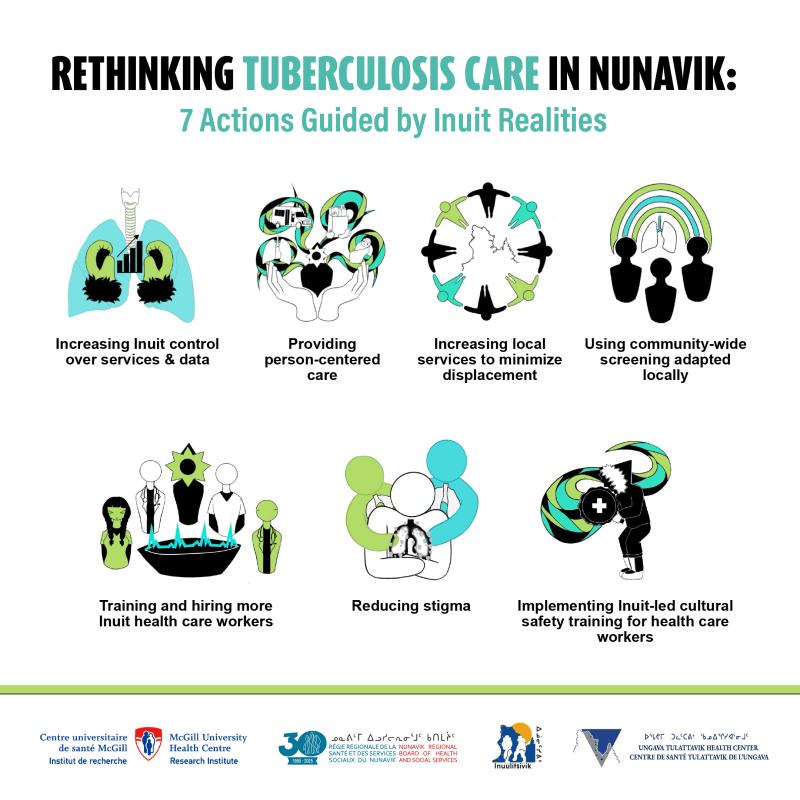
Inuit in the study outlined several concrete solutions grounded in lived realities that could support them in dealing with TB. These ranged from dedicated transportation services (such as a bus for medical appointments), home delivery of medications, help during periods of isolation and screening based on community preferences (e.g. door-to-door).
Inuit were well aware of the importance of a well-resourced clinic, and pointed to expanding access to diagnostic equipment, particularly by increasing the availability of X-ray services in more communities.
Resulting from these recommendations, the authors put forward seven calls to action aimed at transforming how services are organized, prioritizing person-centred care over resource-driven constraints. They include reducing stigma, implementing locally adapted systematic screening, strengthening Inuit leadership in decision-making and ensuring equitable, sustained funding to support solutions tailored to the Nunavik context.
“The methodological approach used in this study is a major strength, as it brings forward perspectives grounded in lived experience and supports Inuit self-determination in knowledge generation,” says co-senior author Dr. Natasha Ita MacDonald, PhD researcher, who is Inuk originally from Kuujjuaraapik.
“Through Indigenous Research Methodology we were led to a nuanced understanding of the challenges related to tuberculosis that we think will help inform recommendations that are better aligned with the cultural and social realities of Nunavik,” adds co-senior author Glenda Sandy, who is a Cree-Naskapi nurse working at the NRBHSS.
Partners mobilized — and a call for stronger government commitment
Several initiatives led by the NRBHSS, IHC and UTHC are currently underway to improve the response to TB in Nunavik, including the sharing of data and statistics with local leaders, the implementation of training for healthcare workers on the history of TB in Nunavik and cultural safety and expanded access to X-ray services in a greater number of communities.
Co-senior author Dr. Faiz Ahmad Khan, a TB specialist who works in Nunavik and a scientist in the Translational Research in Respiratory Diseases Program at The Institute, emphasizes that efforts being made by Nunavik health authorities must be accompanied by urgent and sustained investments from provincial and federal governments. “TB is a medical condition. I don’t see how we will turn the tide on this growing TB epidemic without the provincial government increasing funding both for TB and for general health services in Nunavik.”
“This study reflects what Nunavimmiut have been expressing for years: tuberculosis care must be rooted in the realities, voices and leadership of Inuit communities. While important efforts are underway across Nunavik, we must continue strengthening culturally safe, accessible and community-driven approaches. Ending tuberculosis in Nunavik will require sustained commitment, equitable resources and solutions designed with and for Nunavimmiut,” says Jennifer Munick-Watkins, Executive Director of the Nunavik Regional Board of Health and Social Services.
“Addressing tuberculosis must begin with care that is humane, accessible, and grounded in the realities of Inuit communities. Our responsibility is to protect the health of individuals and families by placing their needs and dignity at the heart of every intervention,” says Larry Watt, Executive Director of the Ungava Tulattavik Health Center.
"Behind every tuberculosis case are Inuit individuals and families facing complex journeys. This study highlights the importance of continuing to strengthen services that are accessible, culturally safe, and grounded in the realities, language, and lived experiences of Nunavimmiut. In this context, it is essential to work in close alignment with communities, listening and working alongside them to ensure care is responsive, supportive, and fully aligned with their needs," says Sarah Beaulne, Executive Director of the Inuulitsivik Health Centre.
Services and care rooted in Nunavimmiut culture
About the study
The study “Inuit experiences and expertise on the 21st century tuberculosis epidemic in Nunavik, Quebec: a qualitative community-based participatory study” is coauthored by Ben Geboe, Glenda Sandy, Daphne Tooktoo, Sophie Tukalak, Stephanie Law, Shirley White-Dupuis, Qiallak Nappaaluk, Nellie Aliqu, Eva Quananack, Maggie Emudluk ; Larry Watt; Pasa Mangiok; Anna Dunn-Suen MSc Madeline Yaaka BSc; Natasha Ita MacDonald and Faiz Ahmad Khan.
DOI: 10.1503/cmaj.251824
Media contacts
For information on the study
Fabienne Landry
Communications Coordinator, Research
McGill University Health Centre
[email protected]
For information on the situation in Nunavik
Yentl Béliard-Joseph
Communications Coordinator
Nunavik Regional Board of Health and Social Services
[email protected]
Nathalie Poirier
Senior Communications Advisor | ᐳᕐᑐᓂᕐᓴᖅ ᑐᓴᕐᑎᓯᒍᑎᑦᓴᓕᕆᔨ
Centre de Santé Tulattavik de l’Ungava | Ungava Tulattavik Health Center | ᐅᖓᕙᒥᑐᓚᑦᑕᕕᐅᑉᖃᓄᐃᖕᖏᓯᐊᕐᑐᓕᕆᕕᖓᓂ
[email protected]
Felicia Potvin
Communication Officer
Inuulitsivik Health Centre ᐃᓅᓕᑦᓯᕕᒃ ᐋᓐᓂᐊᕕᒃ
[email protected]