A critical care manager with an eye on the future
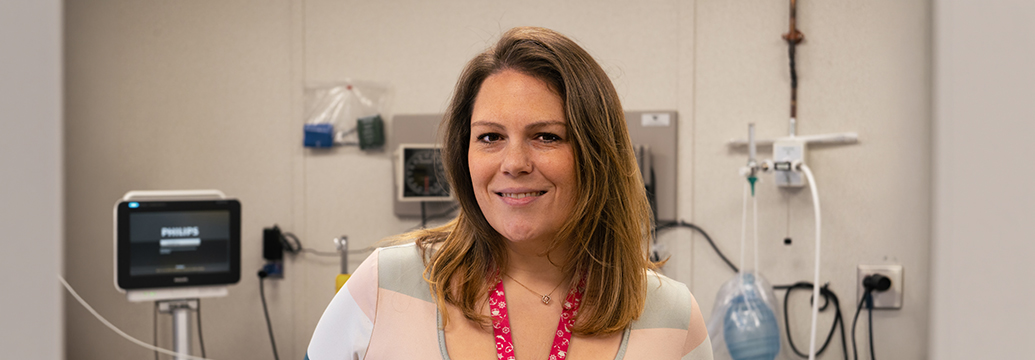
A nursing manager at Lachine Hospital for the past four years, Stéphanie Rose knows the profession well. After holding several clinical positions, including at the Montreal General Hospital, she now oversees critical care, which includes the emergency department and intermediate care.
“The expansion will be a game-changer. Not only will the number of rooms increase, but the building design itself–planned to meet the latest standards–will have a direct impact on the quality of care.”
For her, the hospital’s expansion will mark a true turning point. All rooms will be private and equipped with ventilation, which will help to reduce the risk of hospital-acquired infections. Clinical spaces have also been designed to promote interdisciplinary work: doctors, nurses, licensed practical nurses, nursing assistants, and other professionals will finally have the space they need to collaborate effectively.
A thorough analysis of the spaces
Daily workflows were analyzed through Lean workshops that helped in the design of the floor plans. Storage spaces were carefully thought out–a significant improvement over older hospital layouts, which were often characterized by limited space and crowded hallways. When the new wing opens, these issues will be a thing of the past.
An emergency department redesigned for safety and efficiency
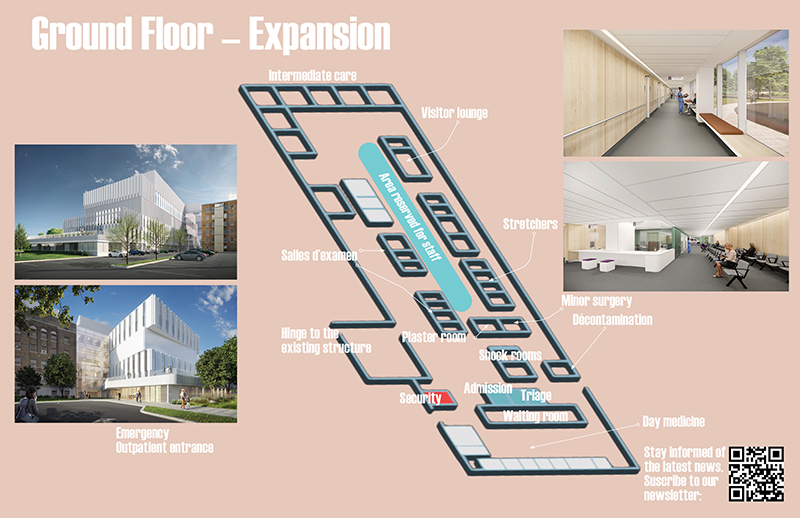
The emergency department waiting room will also benefit from major improvements. The security desk, reception area, and two triage rooms will have a direct view of patients, enhancing both safety and operational flow.
In addition to the central nursing station, the intermediate care unit will be equipped with mini workstations for each pair of rooms. This layout will allow nursing staff to monitor complex cases while continuing their other clinical responsibilities.
Patients will also enjoy a brighter, more calming environment: a spacious wait area, located across from the stretcher bays, will be lined with a large glass window overlooking the park. In short, the team is eagerly awaiting the move.
Recruiting, training and retaining
From the moment she stepped into her role, Stéphanie Rose focused on up-and-coming talent.
“The first thing I did was welcome more students. Today, many of them want to come back and work with us.”
Being part of the MUHC and having university centre status are significant assets. Close ties with McGill University and other educational institutions, including several cégeps in the region, facilitate the recruitment and training of a new generation of professionals.
“We are building a strong team, and I am pleased to see how stable it is. We place a special emphasis on work-life balance, and that is greatly appreciated.”
In the emergency department, there has been no mandatory overtime for about three years–a fact she is especially proud of.
Stéphanie Rose describes her management style as collaborative. “Of course, I have a leadership role, but on a day-to-day basis, it’s a two-way street. The team is involved in decision-making. We talk about stress management; respect is non-negotiable, we encourage autonomy, and we protect our work environment. Valuing personal time helps us provide the best possible care.”
This hands-on management approach, shared with assistant managers, builds strong support for decisions and lasting team cohesion.
A deep connection to the hospital
The journey hasn’t always been easy. At one point, the hospital even had to temporarily close its emergency department. Looking back, Stéphanie Rose sees the strong emotions sparked during that period of uncertainty as proof of how deeply the teams care about their hospital.
At the end of the day, after a busy shift, she walks home – just five minutes away. A proximity that reflects her commitment: professional, but also deeply compassionate and rooted in her community.