Hydrotherapy: a life-changing practice in the NICU
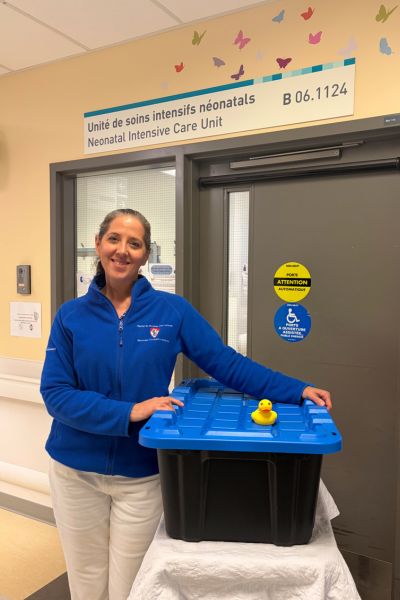
Stephanie Arpin’s practice as a pediatric physiotherapist climbed to new heights after her visit to a neonatal conference in 2018: for the first time, she heard about Hydrotherapy in the NICU, a form of physiotherapy that uses the therapeutic properties of water as an adjunct to developmental interventions with these tiny patients. Stephanie came home to Montreal on a mission to bring hydrotherapy to the Montreal Children’s Hospital (MCH), and for the past six years, she has come to champion the practice in the Neonatal Intensive Care Unit (NICU).
Babies can be sensitive to the stresses of premature birth. For weeks, they have adapted to the challenges of life outside the womb, including discomfort and pain that may persist in their delicate bodies. During a hydrotherapy session, they are gently immersed in a bath of warm water for 10 minutes. Going into the water, their bodies are comfortably swaddled.
As they remain buoyant in the water, they are gradually unswaddled, one leg and one arm at a time. A therapist may gently guide the baby’s pelvis, encouraging movement in a way that feels natural rather than regimented. The baby is supported, soothed and encouraged to move, while also developing strength and motor skills. By the end of the session, babies who were crying are usually calm and no longer crying.
Everything about the intervention is measured: the very dimensions of the basin, how the session progresses minute by minute, and the temperature of the water. Water temperature is established based on what will help maintain the baby’s body temperature, allowing for a smoother transition out of the water. Neonatal hydrotherapy in the NICU is a specialized developmental therapy led by clinicians, unlike a standard bath which simply aims to clean an infant. It involves a 10-minute session and is known to promote blood circulation, range of motion, and comfort.
When 10 minutes are up
Stephanie usually removes the swaddle completely at the 10-minute mark. That way, the baby stays a couple of more moments in the water completely free, completely warm. Then, it’s time to transition out of the tub. Blankets are ready (even warmed blankets) and the baby is swaddled anew. It is now time to clean and disinfect the tub, and Stephanie admits, it is more time-consuming to sanitize than to perform the intervention!
“It is so worth it to me,” she shares. “There’s nothing like seeing a baby relax in your arms.”
The fruit of perseverance
Stephanie is the only physiotherapist in the NICU that currently does hydrotherapy. Remarkably, though, it’s something that almost didn’t happen: when she returned home after the conference, she could not find a basin that fit the required dimensions. She spent the better part of one year looking for something appropriate. How did she stay motivated?
“I didn’t lose motivation while searching because I had a vision. I just felt so strongly that this could be something really beneficial for the patients, and moreover, helpful for the parents. I was thinking about the parents a lot actually,” she recalls. Lo and behold, Stephanie found what she was looking for at Canadian Tire. She even found a yellow rubber ducky that doubles as a thermometer!
“Some parents are emotional and tearful seeing their baby in the water, and they look forward to the next hydrotherapy session. Parents find me in the hallway to ask, ‘Are we going to do hydrotherapy again this week?’”
If a baby shows signs of not liking the water, that’s okay. The session simply ends. Stephanie may try again with the same baby the following week, and parents are usually keen to try one more time. Hydrotherapy is something that a parent or guardian can participate in, which fosters a nurturing bonding experience. The number of hydrotherapy sessions depends on the length of stay. Two or three sessions can suffice during a short stay, but some babies receive as many as 10 to 12 sessions because they are admitted to the NICU for months.
“It’s an honour and a privilege working with these families. I must also thank the NICU team at the Children’s for their openness, especially one nurse and one respiratory therapist who greatly collaborated with me upon my return from the conference. Today, the NICU sees my practice of hydrotherapy as something positive and they help me identify which babies may benefit.”
| September 8 is World Physiotherapy Day. Neonatal hydrotherapy was first pioneered by a woman named Jane Sweeney, who published a peer-reviewed paper in 1983 all about it. Babies must be medically cleared for hydrotherapy and certain contraindications exist. Here at the MCH, hydrotherapy begins at 34 or 35-weeks’ gestation (the baby’s corrected age). |